


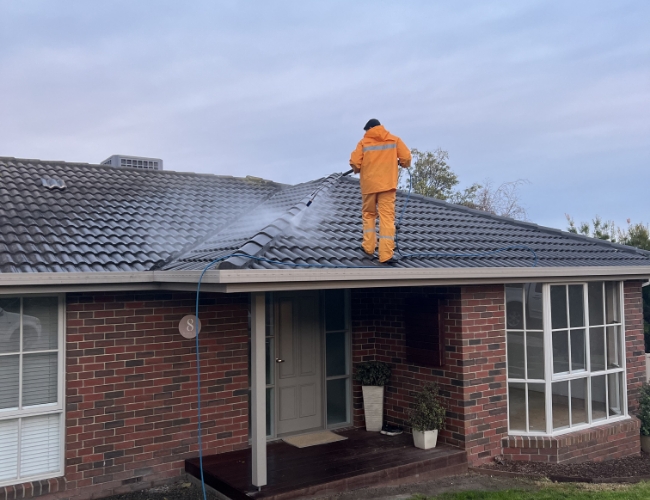
Quick answer: Roof rebedding is replacing the mortar bed that holds the ridge caps onto a tile roof. Roof repointing is applying a new layer of flexible pointing compound over that bed to seal the edges and lock the caps in place. Together, they keep ridge capping secure and watertight.
If you have a tile roof, the ridge capping along the top and hips is its most exposed part. When the mortar under it fails, caps come loose and water gets in. This guide explains what rebedding and repointing are, how to tell which one you need, how the work is done and what it costs in Melbourne.
What is ridge capping?
Ridge caps are the curved or angled tiles that cover the joins where two roof slopes meet. They run along the top of the roof (the ridge) and down the angled corners (the hips).
Ridge caps are not nailed like other tiles. They sit on a bed of mortar and are sealed along the edges with pointing. That makes the bedding and pointing essential to the whole roof.
Bedding vs pointing: the difference
| Bedding | Pointing | |
|---|---|---|
| What it is | The mortar base the ridge caps sit on | The outer layer that seals the bedding and cap edges |
| Material | Sand and cement mortar | Flexible pointing compound |
| Its job | Supports and levels the ridge caps | Seals out water and bonds caps to the tiles |
| How it fails | Cracks, crumbles and loses its grip | Cracks, peels away or falls out |
| The fix | Rebedding: lift caps, remove old mortar, lay a new bed | Repointing: apply new pointing over sound bedding |
Mortar vs flexible pointing
Older roofs were pointed with the same rigid cement mortar used for the bedding. Cement does not flex. Roofs move constantly as they heat and cool, and as the frame shifts slightly. Over time, rigid pointing cracks and falls away.
Modern flexible pointing is a polymer-based compound. It bonds strongly to the tile and the cap, and it stretches with the roof instead of cracking. It also holds its colour.
Eminent Roofing & Restoration uses a flexible pointing compound on every job. It is the current standard for a long-lasting result.
Signs your roof needs rebedding or repointing
You can see most of these from the ground, or with a phone camera on zoom.
- Cracks along the mortar lines of the ridge capping
- Gaps or holes where mortar has fallen out
- Pieces of mortar in the gutters or on the ground
- Ridge caps that look crooked, lifted or out of line
- Ridge caps that have slipped or blown off after strong wind
- Leaks or stains along the centre line of the house
- Moss growing along the ridge line, which holds moisture against the mortar
Repointing only, or a full rebed?
This is the question that decides the cost.
Repointing only is enough when the bedding underneath is still solid and the caps are firm. The roofer cleans the old pointing and applies new flexible pointing over the top.
Rebedding and repointing is needed when the bedding has cracked or crumbled, or the caps move when touched. New pointing over failed bedding will not hold. The caps must be lifted and re-laid first.
On many roofs, some sections need a full rebed and others need repointing only. An honest quote says how many metres of each.
The rebedding and repointing process
- Inspect every ridge and hip to check which caps are loose.
- Lift the ridge caps in the sections where the bedding has failed.
- Remove the old mortar from the tiles and the caps, and clean the surfaces.
- Lay a new mortar bed along both sides of the ridge.
- Re-lay the ridge caps straight and level, and allow the bedding to set.
- Apply flexible pointing along all edges and joins, and tool it to a smooth, sealed finish.
- Clean up mortar and debris from the roof and gutters.
Most homes take one to two days. The pointing needs dry weather to cure properly.
How long does repointing last?
As a general guide, roofs are repointed about every 10 years, depending on weather and material quality. Flexible pointing applied over sound bedding and clean surfaces usually lasts longer than rigid cement pointing, because it moves with the roof instead of cracking.
Surface preparation matters as much as the product. Pointing applied over dust, moss or loose mortar will not bond.
How much does rebedding and repointing cost in Melbourne?
In Melbourne, rebedding and repointing the ridge capping on a full roof typically costs $840 to $3,675, with most jobs around $2,300. Smaller ridge capping repairs typically cost $420 to $1,250.
The price depends on:
- The total length of ridges and hips
- How much needs full rebedding and how much needs repointing only
- Roof height and pitch
- Whether any ridge caps are broken and need replacing
If the roof is also faded or covered in moss, it is often better value to include rebedding and repointing in a full roof restoration.
Can you repoint a roof yourself?
It is not recommended. The work is done at the highest point of the roof. Tiles break easily underfoot, and poorly applied pointing fails quickly or traps water. A professional will also check the bedding, which you cannot assess properly from a ladder.
Frequently asked questions
What is roof repointing? Roof repointing is applying a new layer of flexible pointing compound along the edges of the ridge caps on a tile roof. It seals out water and holds the caps in place.
What is the difference between rebedding and repointing? Rebedding replaces the mortar base under the ridge caps. Repointing replaces the sealing layer on the outside. Rebedding is always followed by repointing.
How often should a roof be repointed? About every 10 years as a general guide. Have the ridge capping checked sooner if you see cracks, loose caps or mortar in the gutters.
Will repointing stop my roof leaking? Yes, if the leak is caused by cracked pointing or loose ridge caps. Leaks from broken tiles, valleys or flashing need a different repair.
Do metal roofs need repointing? No. Metal roofs use metal ridge capping fixed with screws. Rebedding and repointing apply to concrete and terracotta tile roofs.
Get a free roof inspection
Seeing cracked mortar or loose ridge caps? Eminent Roofing & Restoration rebeds and repoints tile roofs across Melbourne’s south-east with flexible pointing and a 10-year workmanship warranty. There’s no deposit: you pay 50% at the halfway point and 50% on completion, and every full restoration comes with a free gutter clean.
Get a free quote → or call 0451 200 159.
Related services: Roof repairs · Roof restoration


Leave a Reply
You must be logged in to post a comment.